When you purchase through links on our site , we may earn an affiliate charge . Here ’s how it works .
The British Isles , tuck out in the northwest of Europe , has been dwell by humans since Paleolithic times , but the people who hold out there did n’t develop a writing system until much later , and the first local story of the islet did not come out until Anglo - Saxon times , around the 7th century A.D.
So who was the first person to write about the British Isles and describe its inhabitants ? To find out , we need to expect to the south — to the Mediterranean world of the ancient Greeks .

Who was the first person on record to write about the British Isles?
A Greek mariner named Pytheas made the first recorded voyage to the British Isles in the quaternary century B.C. He circumnavigate the island of Britain , explored the northern lands of Europe and was the first to describe theCeltictribes of Britain , the midnight sun , dramatic tidal shifts and polar ice . When he devolve home , he write an story call " On the Ocean " ( " Peri tou Okeanou " in Greek ) that circulated wide throughout the ancient world and was show , discussed and debated by scholars for centuries .
Related : Who inherits the British throne ?
Little is know about Pytheas . He was a citizen of Massalia , a Greek colony in what is now Marseilles in southerly France , and it is unsealed whether he was a merchant or simply a gentleman scientist . The Greco - Roman historian Polybius referred to him as a " secret citizen " and a " poor man . " But , whatever his economical or societal condition , Pytheas was a skilled navigator and keen observer .

Who was the first person on record to write about the British Isles?
" We can judge from his writings that Pytheas had a scientific education , " Barry Cunliffe tell Live Science . Cunliffe is an emeritus prof of European archeology at the University of Oxford and author of " The Extraordinary Voyage of Pytheas the Greek " ( Walker & Company , 2002 ) .
Pytheas made a series of astronomical calculations of latitude during this journey with a twist foretell a gnomon , which was an instrument alike to a modern - day sundial . He accurately reckon the circumference of the British Isles — that is , the space around the islands of what is now Great Britain and Ireland — place it at close to 4,000 mile ( 6,400 km),according to the Encyclopedia Britannica . It is not know whether he produced a function from his endeavors , though the first century A.D. Greek geographer Ptolemy , who after made a single-valued function of the British Isles , may have used Pytheas ' measurements and description .
Most historians believe that Pytheas sailed from Massalia through the Straits of Gibraltar ( then known as the Pillars of Hercules ) aboard a trading ship and cruise compass north along the western coasts of what is now Portugal , Spain and France , according to Cunliffe . ( Cunliffe , however , believes Pytheas went overland across France and used local Celtic gravy boat for all water crossings . ) Next , Pytheas crossed the English Channel and made landfall in what is modernistic - sidereal day Cornwall , where he described the flourishing trade oftin , an important trade good that was alloyed withcopperto make bronze .
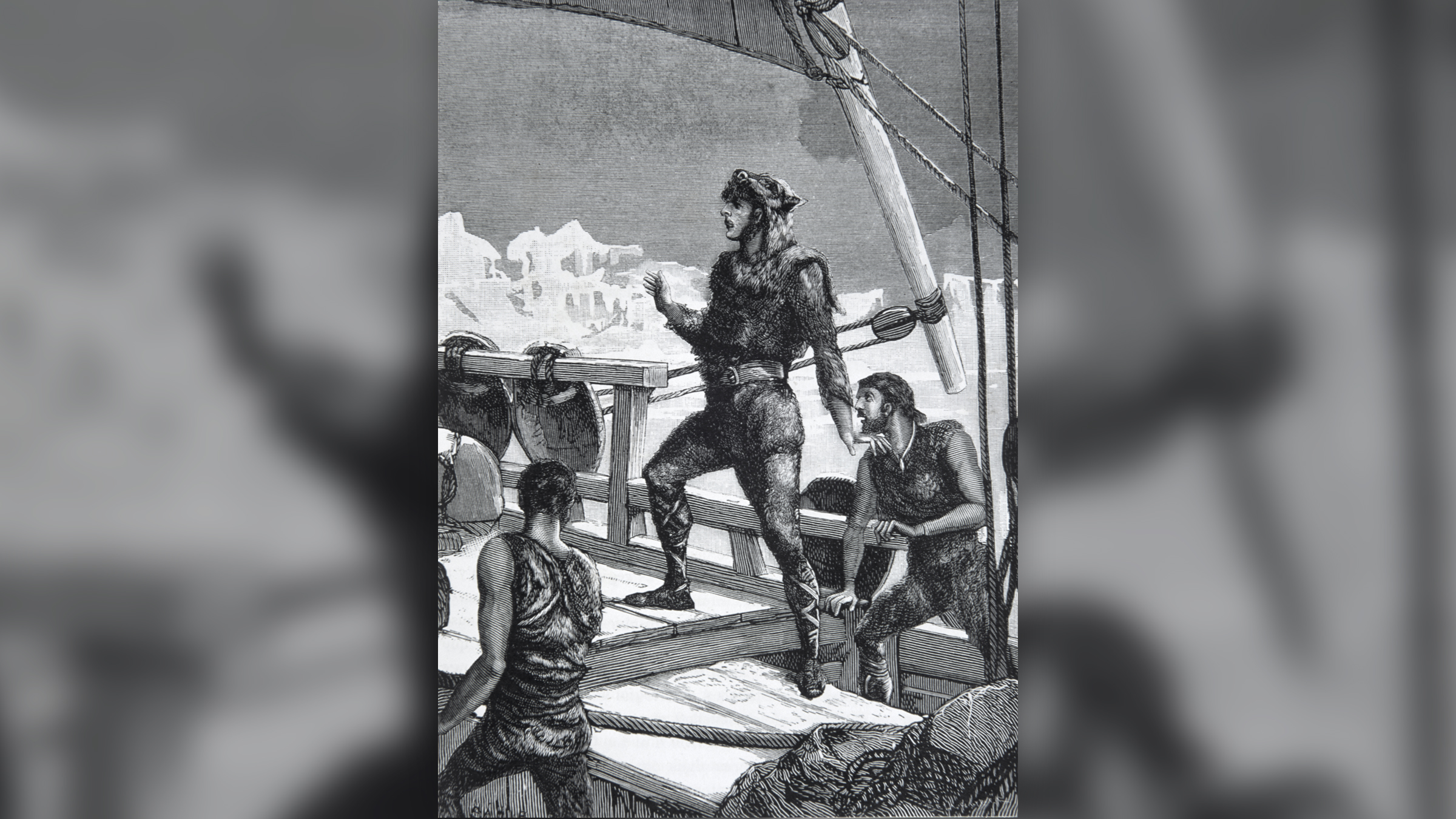
An illustration depicting Pytheas, a Greek explorer who is the first known person to write about the British Isles.
Pytheas continued north along the west coasts of what are now England , Wales and Scotland , where he described the area ’s habitant , a Celtic - mouth people he call the " Pretanni , " or the " paint ones " in the ancient Gaelic terminology , from which the word Britain is derived , according to Cunliffe .
From Scotland , some scholars have argued that Pytheas left Britain and ventured into the North Sea , eventually encountering a land mass he call Thule , which some have identified as Iceland , though others believe it pertain to Norway .
" There is no hard archeologic grounds that Pytheas pass Iceland , " Cunliffe said , " but it ’s not unsufferable . "

Pytheas wrote " On the Ocean " once he returned to Massalia . Until the writings of Tacitus and Julius Caesar some 300 yr later , " On the Ocean " was likely the only source of entropy about Britain and the northern parallel of latitude for most of the world , Cunliffe told Live Science . There were likely copy of Pytheas ’s work in the expectant depository library of Pergamum in what is now Turkey ; Rhodes , Greece ; and Alexandria , Egypt .
— When did the Brits and Yanks become ally again after the Revolutionary War ?
— Why do the queen ’s guards wear such marvellous hats ?

— What was the largest empire in the world ?
Unfortunately , " On the Ocean " has not survived . Only sherd of it remain , rephrase or excerpt in the Ketubim of other Graeco-Roman writer such as Strabo , Polybius , Timaeus , Eratosthenes , Diodorus Siculus and Pliny the Elder . But the fragments we have are significant , Cunliffe aver , as they control a multitude of astronomical , geographical , biological , oceanographic and ethnological observations that have considerable scientific and anthropological meaning .
" If we ’re right about the form of soul Pytheas was — with his razor - penetrative , inquire mind — he would want to pass along all this fresh knowledge , " Cunliffe aver . " He opened up hoi polloi ’s minds to the size of it of the world . "

Originally print on Live Science .


