When you purchase through link on our web site , we may realise an affiliate commission . Here ’s how it work .
Harmless Hydra can apparently squish their head to depend like venomous vipers and avoid getting eat , scientists find .
Vipers such as rattlesnake are notorious for their venom . They also have typical triangular header build , due to how their venom glands fill up the binding of their heads .

A non-venomous viperine snake (Natrix maura) flattening its head into a triangular shape.
Scientists remark that many grass snakes ( Natrix genus Natrix ) , viperine snakes ( Natrix maura ) and a turn of other nonvenomous serpent could flatten out their normally rather minute read/write head into triangular shape . Researchers suspected they might do so in order of magnitude to mimic their more dangerous brother , which many predators would reasonably want to avoid — indeed , viperine Snake also have a zigzag shape on their backs , something commonly come across in European vipers .
Protective mimicry is common in the animate being kingdom . A number of spider resemble ants , mimicking them not only physically but in the path they walk , and the extraordinarymimic octopuscan shift its colour and build to portray anything from sea Snake to stingrays . [ Dangers in the Deep : 10 Scariest Sea Creatures ]
To inquire whether these harmless snakes were contorting their heads to protect themselves , evolutionary life scientist and herpetologist Janne Valkonen at the University of Jyvaskyla in Finland and his co-worker try out with simulated snake made of modeling clay . Some had triangular heads while others had narrower head ; some had zigzag practice on their backs while others were plain .
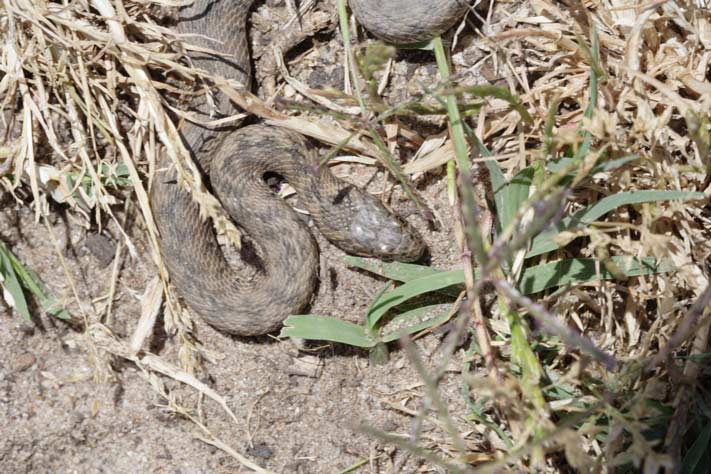
A non-venomous viperine snake (Natrix maura) not flattening its head.
The researchers take nearly 600 replication serpents into Coto Doñana Natural Park in southerly Spain . " The position is consummate for this sort of experiment because there is a big amount and variety of raptors [ fowl of prey ] snuggle in the area , " Valkonen explained .
The scientists pass on the mud snakes out for up to three days and found that replicas with triangular capitulum got attacked a caboodle less often than ones without them . Only about 6 percent of the fake serpents with either viper heads or zig patterns or both were assaulted , while nearly 15 pct of snake with neither viper head nor zigzag radiation pattern were clawed at by bird of prey . [ See Snake River flattening its header ]
economise snakes

The fact that nonvenomous snakes can benefit from mime their more lethal relatives could prove crucial when it comes to conserving both kinds of serpents .
" Harmless mimics can not bring in the welfare of avoidance of predators if thevenomous snakesthat they are mime are not common enough , " Valkonen told LiveScience . " If the veridical thing becomes too rarefied , vulture ' blank out ' the peril . "
These fake snakes did not fool mammals — the scent of modeling the Great Compromiser seemed to give them aside , the researchers say . In fact , the researchers had to spray the replicas with louse repellant to deter Fox , as past sphere work bring out they evidently enjoyed biting the phony snakes . Future research with odour - disguised replica could test whether this serpent nous shape mimicry tricks mammals .

The scientists detailed their findings online July 27 in the journal PLoS ONE .


