The Soviet Union ’s failedKosmos 482Venus spacecraft is arrange to make a somewhat delayed return as it slams into the Earth in the next few days .
Between 1961 and 1984 , the Soviet Union launch a series of space probes so as to study the second - closest satellite to the Sun . The overall programme was a resonant success , withVenera 3becoming the first spacecraft to reach the surface of another planet on March 1 , 1966 . Not far behind it in August 1970 , Venera 7 made thefirst soft landingon another reality , andVenera 9later transmitted the first ever images from the surface of a planet other than our own .
As well as this , the series of probes delivered the first audio frequency from another earth , and made in high spirits - resolving power microwave radar scans of the Morning Star . Side note , but it ’s definitely worth checking out theonly image ever taken of the surface of Venus .
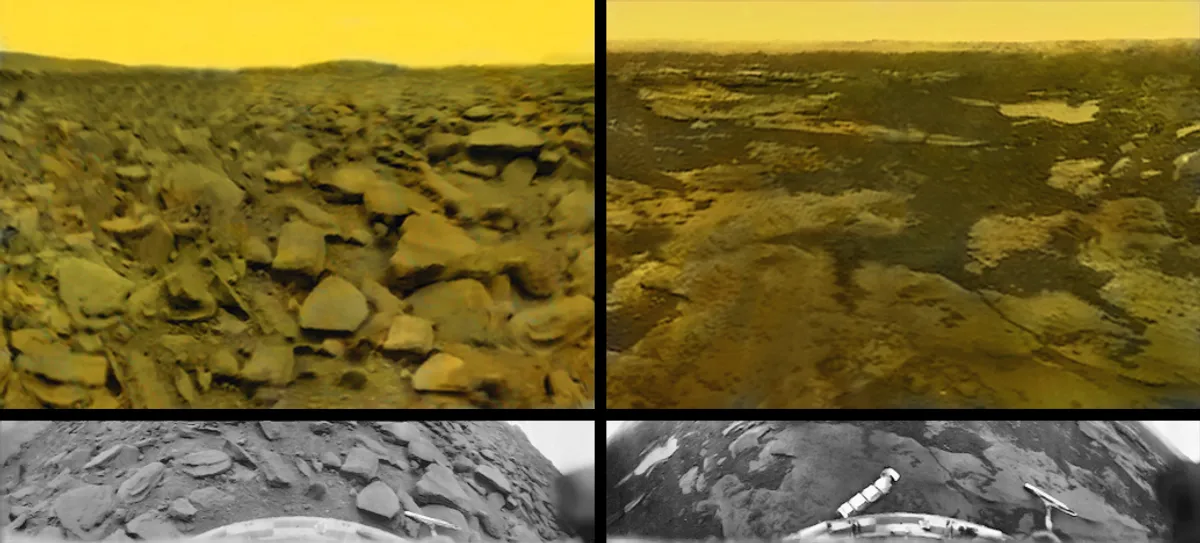
The surface of Venus, captured by the Venera 9 and Venera 10 probes.Image Credit: Russian Academy of Sciences, courtesy of Ted Stryk
regrettably , as is often the showcase with sending ballistic capsule fly into the Solar System , not all of the probe made it to their final destination . One investigation , launched in 1972 , fail to make it to its target , earn it the name Kosmos 482 .
" Beginning in 1963 , the name Cosmos was give to Soviet ballistic capsule which remained in Earth orbit,“NASA excuse , " regardless of whether that was their mean final destination . "
The spacecraft , designed to withstand the thick air of Venus , hit trouble soon after launching .
" After achieve an Earth parking celestial orbit , the spacecraft made an apparent attempt to launch into a Venus transference trajectory,“NASA explains . " It split into four pieces , two of which remained in broken Earth orbit and decayed within 48 hours , and two art object ( presumptively the freight and detach upper level engine building block ) went into a gamey 210 x 9800 klick orbit . It is thought that a malfunction resulted in an railway locomotive burn mark which did not achieve sufficient velocity for the Venus transferral and left the payload in this elliptical Earth orbit . "
The declination craft has been in thishighly ellipticalorbit around Earth ever since . Unfortunately , the space vehicle ’s orbit has also crumble , bring it nearer to the planet . harmonize to current foretelling from satellite analystMarco Langbroek , who has tracked the Kosmos 482 for twelvemonth , the spacecraft will impact Earth on May 10 , 2025 , at 7:34 UTC , give or take around 15 60 minutes .
While the object is small and by no means a threat to a tumid sphere , it will be an interesting re - entranceway , and not one you ’d like to be around when it bring down .
" As this is a lander that was designed to come through passing through the Venus ambiance , it is possible that it will survive reentry through the Earth atmosphere intact , and impact intact , " Langbroek explains on theSatTrackCam Leiden blog .
" The risk involved are not peculiarly high , but not zero : with a mass of just under 500 kilogram and 1 - meter size , risks are similar to that of a meteorite shock . "
" It likely will be a hard wallop : I doubt the parachute deployment organization will still sour after 53 years and with dead battery , " he added .
ⓘ IFLScience is not responsible for content shared from external internet site .
At present , the lander has an orbital inclination of 51.95 degrees , and could hit parts of Europe , Asia , the Americas , Australia , or Africa , though , sacrifice the huge total of sea on our planet , a watery last is most potential .
foretelling may transfer as the spacecraft draw near . The craft has an assumed mountain of 480 kilograms , but this is n’t certain , whilespace weathercan also play a part in cut off space vehicle orbits . Langbroek willprovide updatesas the aging Soviet ballistic capsule makes its approaching to Earth .
